---
title: "Texas Tree Care Guide: How to Water, Mulch, Feed, and Protect Your Trees"
description: "exas tree care made simple: expert tips on watering clay and rocky soils, mulching, fertilizing stressed trees, and catching drought stress early."
image: https://blog.moonvalleynurseries.com/hubfs/summer-tree-care.png
---
# Texas Tree Care Guide: How to Water, Mulch, Feed, and Protect Your Trees
By [Blog](https://blog.moonvalleynurseries.com/author/blog) on October, 21 2026
### Topics
- Select a Topic
- [All](https://blog.moonvalleynurseries.com)
- [Landscape Tips](https://blog.moonvalleynurseries.com/topic/landscape-tips)
- [Tree Highlights](https://blog.moonvalleynurseries.com/topic/tree-highlights)
- [Design Tips](https://blog.moonvalleynurseries.com/topic/design-tips)
- [Tree Maintenance](https://blog.moonvalleynurseries.com/topic/tree-maintenance)
- [Citrus and Fruit](https://blog.moonvalleynurseries.com/topic/citrus-and-fruit)
- [Spring Tips](https://blog.moonvalleynurseries.com/topic/spring-tips)
- [Winter Tips](https://blog.moonvalleynurseries.com/topic/winter-tips)
- [Fertilizers](https://blog.moonvalleynurseries.com/topic/fertilizers)
- [Fall Tips](https://blog.moonvalleynurseries.com/topic/fall-tips)
- [Flowering Trees](https://blog.moonvalleynurseries.com/topic/flowering-trees)
- [Inspiration](https://blog.moonvalleynurseries.com/topic/inspiration)
- [Summer Tips](https://blog.moonvalleynurseries.com/topic/summer-tips)
- [Planting Tips](https://blog.moonvalleynurseries.com/topic/planting-tips)
- [Christmas Trees](https://blog.moonvalleynurseries.com/topic/christmas-trees)
- [Gardening](https://blog.moonvalleynurseries.com/topic/gardening)
- [Hollywood Hedges](https://blog.moonvalleynurseries.com/topic/hollywood-hedges)
- [Environmental, Social and Governance (ESG)](https://blog.moonvalleynurseries.com/topic/environmental-social-and-governance-esg)
- [Houseplants](https://blog.moonvalleynurseries.com/topic/houseplants)
- [Shade Trees](https://blog.moonvalleynurseries.com/topic/shade-trees)
- [Evergreen Trees](https://blog.moonvalleynurseries.com/topic/evergreen-trees)
- [Heat Tolerant Plants](https://blog.moonvalleynurseries.com/topic/heat-tolerant-plants)
- [Pest Control](https://blog.moonvalleynurseries.com/topic/pest-control)
- [Cacti](https://blog.moonvalleynurseries.com/topic/cacti)
- [Orange Tree](https://blog.moonvalleynurseries.com/topic/orange-tree)
- [Xeriscape](https://blog.moonvalleynurseries.com/topic/xeriscape)
- [Community Projects](https://blog.moonvalleynurseries.com/topic/community-projects)
- [Giving Back](https://blog.moonvalleynurseries.com/topic/giving-back)
- [Heat-Tolerant Annuals](https://blog.moonvalleynurseries.com/topic/heat-tolerant-annuals)
- [Heat-Tolerant Perennials](https://blog.moonvalleynurseries.com/topic/heat-tolerant-perennials)
- [Indian Laurel](https://blog.moonvalleynurseries.com/topic/indian-laurel)
- [Japanese Blueberry Tree](https://blog.moonvalleynurseries.com/topic/japanese-blueberry-tree)
- [Lime Tree](https://blog.moonvalleynurseries.com/topic/lime-tree)
- [Monsoon](https://blog.moonvalleynurseries.com/topic/monsoon)
- [Palm Trees](https://blog.moonvalleynurseries.com/topic/palm-trees)
- [Patio Planter](https://blog.moonvalleynurseries.com/topic/patio-planter)
- [Shrubs](https://blog.moonvalleynurseries.com/topic/shrubs)
- [Soil Erosion](https://blog.moonvalleynurseries.com/topic/soil-erosion)
- [Wholesale](https://blog.moonvalleynurseries.com/topic/wholesale)
### Stay up to date
[SUBSCRIBE TO OUR BLOG](https://go.moonvalleynurseries.com/marketing-communication-sign-up)
### Stay up to date
##### Search The Blog
[Back to main Blog](https://blog.moonvalleynurseries.com)
###### Blog
Texas trees face a unique mix of challenges: long stretches of heat, periodic drought, heavy clay in some regions, and shallow, rocky, limestone-based soils in others. Because conditions vary so much across the state, no one-size-fits-all approach works for tree care. This guide, developed with insights from a professional tree care specialist, explains how to care for trees in Texas based on what is actually happening in your soil, your tree, and your local weather.
## **Key Takeaways**
- **Roots stay active longer than you think.** Tree roots can keep growing through much of fall and winter when soil temperature and moisture are favorable.
- **Water by soil, not by calendar.** Irrigation frequency depends on soil texture, root-zone depth, tree age, weather, drainage, and current soil moisture.
- **Overwatering is a common problem.** Texas A&M notes that overwatering often causes problems after planting.
- **Mulch 2–3 inches deep** and keep it clear of the trunk and root flare.
- **Stabilize stressed trees before feeding them.** Drought-stressed trees need water and root-zone care before they can handle significant nitrogen.
- **Symptoms are not a diagnosis.** Heat stress, drought stress, pests, disease, and nutrient problems can all look alike.
## **Do Tree Roots Grow in Fall and Winter in Texas?**
Yes. Tree roots can remain active through much of the [fall and winter](https://blog.moonvalleynurseries.com/texas/the-art-of-winter-watering-essential-tips-for-plant-care) when soil temperatures and moisture conditions are favorable. Root growth generally slows as soil temperatures decline, but the timing varies by species, soil conditions, and location.
In much of Texas, root activity may slow in December and January. However, these months aren't universally dormant. Depending on where you live and the weather, your trees' roots may still be working below the surface.
## **How to Water a Newly Planted Tree (and How Often)?**
No single watering schedule works for every Texas landscape. How often you should irrigate depends on several factors:
- Soil texture
- Root-zone depth
- Tree age
- Weather
- Drainage
- Current soil moisture
### **Watering Trees in Clay Soil**
Clay soils generally require less frequent irrigation and careful monitoring. Because clay holds water longer, watering too often can keep the root zone saturated.
### **Watering Trees in Shallow, Rocky, or Limestone Soil**
Shallow, rocky, or limestone-dominated soils may need smaller, more frequent water applications because they hold less water in the root zone.
### **How to Check Soil Moisture Around Your Tree**
Before you water, check the soil. You can evaluate soil moisture with a soil probe, a screwdriver, a piece of rebar, or simply by hand. Checking first helps you avoid both underwatering and overwatering.
## ****
## **How to Water Newly Planted Trees**
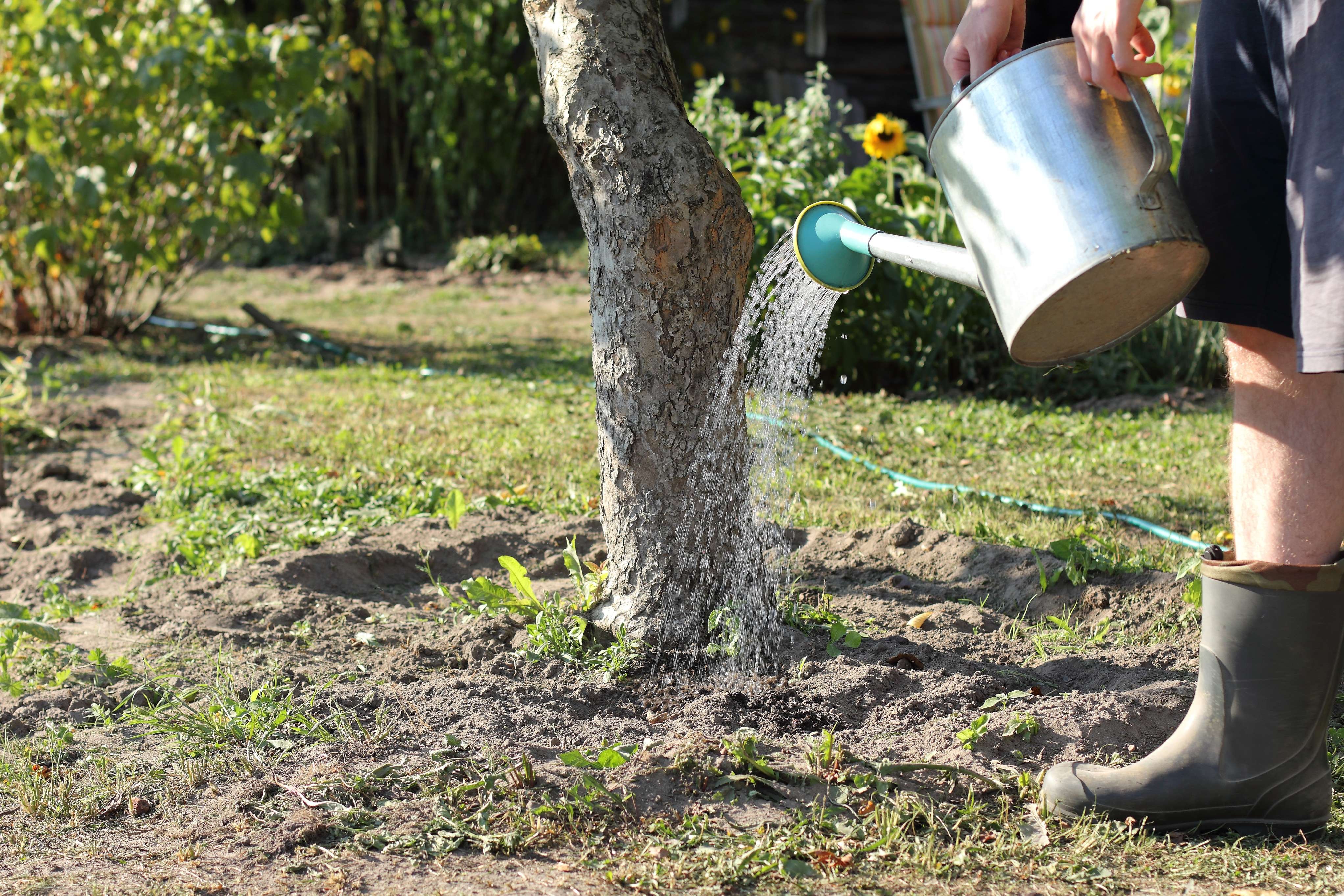
Newly planted trees need water delivered where it matters most: the root zone.
- **Target the root zone, not the trunk.** Direct water to the root zone rather than routinely watering the trunk.
- **Moisten without saturating.** Irrigation should adequately moisten the root zone while avoiding prolonged saturation.
- **Encourage roots to spread.** As roots establish, gradually adjust irrigation to encourage them to expand beyond the original root ball.
Be careful not to overdo it. Texas A&M emphasizes that overwatering often causes problems after planting.
## **Deep Watering Established and Mature Trees**
Larger, established trees can have much greater total water demand because of their larger canopies and higher transpiration rates. That said, water requirements vary considerably from tree to tree and site to site.
Treat fixed gallon-per-day figures or universal weekly watering schedules as general examples, not prescriptions. Use [soil moisture checks](https://blog.moonvalleynurseries.com/texas/perfecting-the-pour-watering-tips-for-healthy-trees-plants) and your tree's condition to guide how much and how often you water.
## **When Do Trees Grow in Texas?**
Tree growth responds primarily to environmental conditions rather than to the calendar alone. Several factors influence when a tree goes dormant and when it actively grows:
- Temperature
- Soil moisture
- Photoperiod (day length)
- Species
- Local weather
This is why two trees of the same species in different parts of Texas may leaf out, grow, or slow down at different times.
## **How to Mulch Around a Tree**
[Properly applied mulch](https://blog.moonvalleynurseries.com/mulch-101) is one of the most effective ways to support tree health in Texas. Mulch helps:
- Conserve soil moisture
- Moderate soil temperature
- Reduce weed competition
- Protect soil from environmental stress
### **How Much Mulch Should You Use?**
A moderate layer of mulch, generally **2–3 inches thick**, is preferable to excessive mulch. Too much mulch can interfere with water and oxygen movement through the soil.
### **Keep Mulch Away From the Trunk**
Keep mulch clear of the trunk and the root flare (the area where the trunk widens at the base).
### **Pro Tip: Put Irrigation Under the Mulch**
Placing soaker hoses and drip lines under the mulch helps conserve water. Mulch insulates the soil and reduces evaporation.
## **Should You Fertilize a Stressed Tree?**
Not right away. Severely [drought-stressed trees](https://blog.moonvalleynurseries.com/texas/combating-drought-moon-valley-nurseries-strategy-for-tree-survival) should generally be stabilized with appropriate watering and root-zone management before applying significant nitrogen.
Base fertilization on the tree's condition, soil conditions, and nutrient needs, not a set schedule. A [soil test](https://blog.moonvalleynurseries.com/texas/soil-savvy-tailoring-fertilization-for-optimal-growth) can help determine whether nutrient availability is actually limiting your tree's growth.
## **Iron Chlorosis: Why Tree Leaves Turn Yellow in Central Texas**
Iron chlorosis is a significant issue in portions of Central Texas. Alkaline, calcareous, and limestone-derived soils can reduce the amount of iron available to trees.
Soil iron does not necessarily mean the tree can take it up. Corrective treatment depends on:
- Soil chemistry
- Tree species
- Severity of the chlorosis
- The form of iron used
## **Signs of Heat and Drought Stress: Leaf Scorch, Wilting & Leaf Drop**
[Heat and drought stress](https://blog.moonvalleynurseries.com/texas/understanding-early-color-change-in-texas-trees-a-sign-of-stress-or-a-seasonal-shift) can produce symptoms that resemble insect, disease, and nutritional problems. Common symptoms include:
- Wilting
- Leaf scorch
- Marginal necrosis (browning along leaf edges)
- Premature browning
- Leaf drop
These symptoms are not diagnostic on their own. A proper diagnosis requires considering soil moisture, root condition, pests, pathogens, nutrition, and environmental conditions together.
## **Why Are My Tree's Leaves Smaller Than Normal?**
Smaller leaves can indicate impaired root function, inadequate water or nutrient availability, or other forms of physiological stress. However, don't automatically attribute it to a root-uptake problem.
Leaf expansion occurs primarily during early leaf development, so the conditions a tree experiences during that period strongly influence its final leaf size.
## **Texas Tree Care at a Glance**
| **Topic** | **What to Know** |
| --- | --- |
| Root growth | Roots can stay active in fall and winter; December and January may be slower, but roots aren't universally dormant. |
| Watering | Base watering on soil type, root depth, tree age, weather, drainage, and soil moisture. |
| Clay soil | Water less frequently and monitor carefully. |
| Rocky or limestone soil | Use smaller amounts of water more frequently. |
| New trees | Water the root zone, not the trunk; avoid prolonged saturation. |
| Mature trees | Higher total water demand; treat fixed schedules as examples only. |
| Mulch | 2–3 inches, kept clear of the trunk and root flare. |
| Fertilizer | Stabilize stressed trees first; use soil testing to guide feeding. |
| Iron chlorosis | Common in alkaline Central Texas soils; treatment depends on soil and species. |
| Heat/drought stress | Symptoms mimic other problems; diagnose using all factors. |
## ****
## **Frequently Asked Questions About Texas Tree Care**
### **How often should I water my trees in Texas?**
It depends on your soil texture, root-zone depth, tree age, weather, drainage, and current soil moisture. Clay soils generally need less frequent watering, while shallow, rocky, or limestone soils may need smaller, more frequent applications. Check soil moisture before watering.
### **Are trees dormant in Texas in winter?**
Not necessarily. Roots can remain active through much of fall and winter when soil temperature and moisture are favorable. December and January may reduce root activity in much of Texas, but trees are not universally dormant.
### **Can you overwater a newly planted tree?**
Yes. Texas A&M emphasizes that overwatering commonly causes problems after planting. Water should moisten the root zone without keeping it saturated for long periods.
### **How deep should mulch be around a tree?**
Generally around 2–3 inches. Keep mulch away from the trunk and root flare, since too much mulch can interfere with water and oxygen movement in the soil.
### **Should I fertilize a drought-stressed tree?**
Severely drought-stressed trees should generally be stabilized with proper watering and root-zone management before applying significant nitrogen. A soil test can show whether nutrients are actually limiting growth.
### **What causes yellow leaves on trees in Central Texas?**
One common cause is iron chlorosis. Alkaline, calcareous, and limestone-derived soils in parts of Central Texas can reduce iron availability, even when iron is present in the soil.
## **Get Expert Help Caring for Your Texas Trees**
Healthy trees start with care that fits your soil, your climate, and your specific trees. If you have questions about watering, mulching, fertilizing, or signs of stress in your landscape, [schedule a professional tree care consultation with Moon Valley Nurseries](https://www.moonvalleynurseries.com/tree-care) today.
Share On:
[Previous Post](https://blog.moonvalleynurseries.com/the-trophy-tree-trend-is-real-heres-what-mature-trees-actually-cost)
#### Submit a Comment
```json
{
"@context" : "https://schema.org",
"@type" : "BlogPosting",
"author" : {
"@type" : "Person",
"name" : "Blog",
"url" : "https://blog.moonvalleynurseries.com/author/blog"
},
"dateModified" : "2026-10-21T15:09:44.503Z",
"datePublished" : "2026-10-21T13:23:02.000Z",
"headline" : "Texas Tree Care Guide: How to Water, Mulch, Feed, and Protect Your Trees",
"image" : [ "https://blog.moonvalleynurseries.com/hubfs/summer-tree-care.png" ],
"mainEntityOfPage" : {
"@id" : "https://blog.moonvalleynurseries.com/texas-tree-care-guide-how-to-water-mulch-feed-and-protect-your-trees",
"@type" : "WebPage"
},
"publisher" : {
"@type" : "Organization",
"logo" : {
"@type" : "ImageObject",
"url" : "https://blog.moonvalleynurseries.com/hubfs/jpg%20small%20for%20pdfs-1.jpg"
},
"name" : "Moon Valley Nursery, Inc."
}
}
```
```json
{
"@context" : "http://schema.org",
"@type" : "NewsArticle",
"author" : [ {
"@type" : "Person",
"name" : "Blog",
"url" : "https://blog.moonvalleynurseries.com/author/blog"
} ],
"dateModified" : "1792595384510",
"datePublished" : "2026-10-21 13:23:02",
"headline" : "Texas Tree Care Guide: How to Water, Mulch, Feed, and Protect Your Trees",
"image" : [ "https://1546852.fs1.hubspotusercontent-na1.net/hubfs/1546852/summer-tree-care.png" ]
}
```
```json
{
"@context" : "https://schema.org",
"@id" : "https://blog.moonvalleynurseries.com/texas-tree-care-guide-how-to-water-mulch-feed-and-protect-your-trees#faq",
"@type" : "FAQPage",
"mainEntity" : [ {
"@type" : "Question",
"acceptedAnswer" : {
"@type" : "Answer",
"text" : "It depends on your soil texture, root-zone depth, tree age, weather, drainage, and current soil moisture. Clay soils generally need less frequent watering, while shallow, rocky, or limestone soils may need smaller, more frequent applications. Check soil moisture before watering."
},
"name" : "How often should I water my trees in Texas?"
}, {
"@type" : "Question",
"acceptedAnswer" : {
"@type" : "Answer",
"text" : "Not necessarily. Roots can remain active through much of fall and winter when soil temperature and moisture are favorable. December and January may reduce root activity in much of Texas, but trees are not universally dormant."
},
"name" : "Are trees dormant in Texas in winter?"
}, {
"@type" : "Question",
"acceptedAnswer" : {
"@type" : "Answer",
"text" : "Yes. Texas A&M emphasizes that overwatering commonly causes problems after planting. Water should moisten the root zone without keeping it saturated for long periods."
},
"name" : "Can you overwater a newly planted tree?"
}, {
"@type" : "Question",
"acceptedAnswer" : {
"@type" : "Answer",
"text" : "Generally around 2–3 inches. Keep mulch away from the trunk and root flare, since too much mulch can interfere with water and oxygen movement in the soil."
},
"name" : "How deep should mulch be around a tree?"
}, {
"@type" : "Question",
"acceptedAnswer" : {
"@type" : "Answer",
"text" : "Severely drought-stressed trees should generally be stabilized with proper watering and root-zone management before applying significant nitrogen. A soil test can show whether nutrients are actually limiting growth."
},
"name" : "Should I fertilize a drought-stressed tree?"
}, {
"@type" : "Question",
"acceptedAnswer" : {
"@type" : "Answer",
"text" : "One common cause is iron chlorosis. Alkaline, calcareous, and limestone-derived soils in parts of Central Texas can reduce iron availability, even when iron is present in the soil."
},
"name" : "What causes yellow leaves on trees in Central Texas?"
} ]
}
```
```json
{
"@context" : "https://schema.org",
"@id" : "https://blog.moonvalleynurseries.com/texas-tree-care-guide-how-to-water-mulch-feed-and-protect-your-trees#breadcrumb",
"@type" : "BreadcrumbList",
"itemListElement" : [ {
"@type" : "ListItem",
"item" : "https://www.moonvalleynurseries.com/",
"name" : "Home",
"position" : 1
}, {
"@type" : "ListItem",
"item" : "https://blog.moonvalleynurseries.com/",
"name" : "Blog",
"position" : 2
}, {
"@type" : "ListItem",
"name" : "Texas Tree Care Guide: How to Water, Mulch, Feed, and Protect Your Trees",
"position" : 3
} ]
}
```